
Boxelder Bug Control in Wisconsin: Why They Come Back Every October
October 12, 2026
Boxelder bugs return to the same Wisconsin homes every October because of the house itself, not the yard: a sunny south or west facing wall that holds afternoon heat, with small gaps around siding, windows, soffits and utility lines that lead into the wall voids where these insects spend the winter. Killing the bugs you can see solves today. Changing how they get in is what breaks the cycle.
Every fall the phones at 1st Choice Pest Solutions ring with the same story from Eau Claire, Chippewa Falls, Green Bay and the towns in between. The bugs showed up on the siding in late September. By the second week of October there were hundreds. Now they are inside, crawling across the living room ceiling on the first warm afternoon in November, and the homeowner wants to know why it happens here, year after year, when the neighbor two doors down barely sees one.
This guide walks through what is going on, what does not work, and what a real boxelder bug control plan looks like in western Wisconsin.
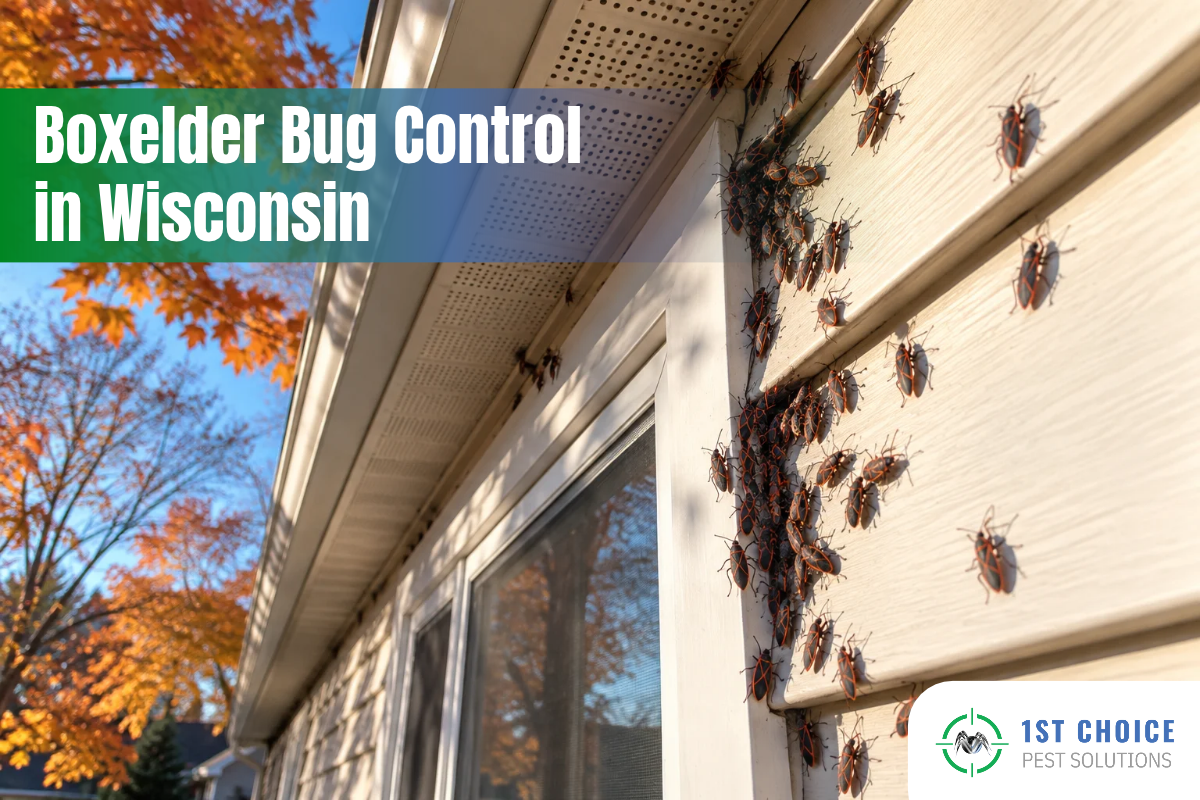
Why October Is Boxelder Bug Season In Wisconsin
Boxelder bugs spend the warm months outdoors doing very little that anyone notices. Adults feed on the seeds of boxelder, maple and ash trees, lay eggs in bark crevices, and the new generation grows through the summer. They are not damaging your trees in any meaningful way, and they are not breeding in your walls.
Then the nights get cold. Once Wisconsin starts dropping into the thirties overnight while the afternoons still reach the sixties, these insects begin looking for a place to overwinter. That search is driven almost entirely by heat. On a bright October afternoon, the south side of a house can be twenty degrees warmer than the shaded side, and that warm siding draws boxelder bugs the way a porch light draws moths.
What happens next is simple. They land on the wall, they warm up, and they start walking. Any crack they find gets explored. Behind the siding, under the soffit, around the dryer vent, through the gap where a cable enters the house, into the window weep holes. Once they are inside the wall void, they go quiet for the winter.
Boxelder Bugs In The House: What They Actually Do
Here is the part most homeowners are relieved to hear. Boxelder bugs do not bite, they do not sting, they do not carry disease, they do not chew wood, and they do not reproduce indoors. They are a nuisance pest in the truest sense.
That said, nuisance is not the same as harmless to your sanity. A heavy infestation brings real problems:
- They stain. Crushed boxelder bugs leave a reddish orange smear on curtains, carpet, painted trim and light-colored upholstery.
- They smell. The same defensive compound that deters birds smells sharply unpleasant when a vacuum sucks up a few dozen of them.
- They wake up at the wrong time. A warm January day, or a wall that sits against a heated room, convinces a cluster of bugs that spring has arrived. They crawl toward light, which means they come out at the window, the ceiling fixture or the bathroom vent rather than back outside.
- They keep coming. Because they are emerging from inside the wall, there is no door you can close. Homeowners often sweep up bugs in February and assume new ones are getting in, when really, they have been in the structure since Halloween.
Dogs and cats that eat a few generally do fine, though the taste tends to discourage repeat performances.
The Boxelder Tree Connection, And Why Removing The Tree Is Rarely The Answer
Female boxelder trees produce the seeds these bugs prefer, so a yard with one or two mature boxelders often has a bigger population than a yard without. Maples and ash trees support them as well.
Cutting down the tree sounds like the clean fix. In practice it usually disappoints, for two reasons. Boxelder bugs fly, and they will travel from trees well beyond your property line to reach a warm wall they like. And a mature shade tree is worth a great deal to a Wisconsin yard, which makes it an expensive trade for a problem that exclusion work handles better.
Tree removal is worth considering when a female boxelder is growing right against the house, is in poor condition anyway, or is already scheduled to come out. Otherwise, treat the building.

The Real Reason They Come Back To The Same House
Three things make a house a repeat target, and all three are fixable.
The first is sun exposure. A large unshaded south or west wall is a heat collector. You cannot change which way your house faces, but you can change what the bugs find when they land there.
Second comes the gap inventory. Older homes in Eau Claire and Chippewa Falls often have original wood windows, settled foundations and siding that has pulled slightly away at the corners. Newer construction has its own weak points: unsealed utility penetrations, poorly fitted soffit vents, and ridge vents that were never screened. A boxelder bug needs very little room, about the thickness of a nickel.
Third is the population already living in the structure. Bugs that overwintered successfully last year leave behind an aggregation scent that helps the next generation find the same spot. A house that has hosted them for five winters is more attractive than a house that has never hosted them at all, which is why the problem tends to get worse rather than better if nothing changes.
What Does Not Work
Homeowners try a lot of things before they call. A few are worth skipping:
- Spraying the bugs you see on the siding with a hardware store aerosol. It kills those individuals and does nothing about the hundreds arriving behind them or the ones already in the wall.
- Dish soap and water. It works on direct contact and leaves no residue at all, so the next wave lands five minutes later.
- Bug bombs and foggers indoors. The bugs are in wall voids where the fog does not reach, and you have now treated your living space for no benefit.
- Spraying inside the wall through an outlet. Dead insects in a wall void attract carpet beetles and other secondary pests, and the smell has nowhere to go.
- Waiting it out. They are not a one-year event. The scent cue and the unsealed gaps both carry over.
Vacuuming, on the other hand, is genuinely useful indoors. Use a shop vacuum or a bag you can throw away immediately, and you avoid both the stain and the odor.
How Professional Boxelder Bug Control Works
A real program has two halves, and the order matters.
The first half is exclusion, which means closing the routes. A technician from 1st Choice Pest Solutions walks the building looking at the places these insects actually use siding corner joints, window and door frames, utility and dryer vent penetrations, soffit and ridge vent screening, foundation sill gaps, and the weep holes in brick veneer. Some of that gets sealed on the spot. Some of it is carpentry or siding work the homeowner schedules separately, and we will tell you plainly which is which.
The second half is a timed exterior treatment. A residual product applied to the sunny walls, the foundation band, around window and door frames and under the soffit line puts a barrier exactly where the bugs land and walk. Timing is what makes it work. Applied in late summer or very early fall, before the mass movement starts, the treatment intercepts bugs on the wall rather than chasing them after they are inside. Applied in November, it is far less useful, because most of the population is already in the voids.
For houses with a long history, we usually recommend pairing the fall application with a spring visit, since the same treated surfaces catch bugs on the way back out and reduce the number that make it to the trees to breed. You can see how this fits with the rest of a year-round plan on our residential pest control services page.
“When I arrive at a Wisconsin home in October with boxelder bugs covering the south-facing wall, I first inspect the windows, doors, and garage areas, where the bugs tend to gather and look for ways inside. One of the most commonly overlooked entry points is the small gaps around door frames, garage door seals, and weatherstripping that homeowners don’t realize have worn down or no longer seal properly.”Steve, Technician, 1st Choice Pest Solutions
A Realistic Timeline For Breaking The Cycle
| Time Of Year | What The Bugs Are Doing | What Helps Most |
|---|---|---|
| Late winter to early spring | Emerging from wall voids indoors, moving toward light and windows | Vacuum indoors, note every room where they appear so the gaps can be traced |
| Spring | Leaving the structure, returning to boxelder and maple trees to feed and lay eggs | Exterior treatment on sunny walls, seal gaps found over winter |
| Summer | Developing outdoors on and around host trees, largely unnoticed | Carpentry, siding, screening and sealing work while the weather is good |
| Late summer to early fall | Adults massing on warm walls, beginning to probe for entry | Timed exterior residual application, this is the highest value window |
| October to November | Entering wall voids to overwinter | Vacuum what gets inside, treatment now is damage control rather than prevention |
The honest summary is that the work you do in August and September decides what October looks like. A house treated once in the middle of an active invasion will see improvement. A house that gets exclusion plus a properly timed application sees a different scale of result the following year.
When To Call 1st Choice Pest Solutions
Call when the bugs are showing up indoors rather than only on the siding, when the population on the wall is in the hundreds rather than the dozens, when it has happened more than two years running, or when you simply do not want to be on a ladder at the soffit line in October.
Our technicians cover Eau Claire, Chippewa Falls, Green Bay and the surrounding communities across western Wisconsin. You can check your town on our service areas page, and if you are assessing what a treatment plan runs against what you are spending on sprays and your own weekends, our guide to what pest control costs in Wisconsin is a useful starting point.
Ready to stop repeating this every fall? Call 1st Choice Pest Solutions at (715) 271-2511 or request a free estimate and we will walk the building with you.
Frequently Asked Questions
Are boxelder bugs dangerous to people or pets?
No. Boxelder bugs do not bite, sting or transmit disease, and they do not damage the structure of a home. The problems they cause are staining, odor and sheer numbers. A pet that eats one or two is generally fine, though the taste usually stops them from trying again.
Do boxelder bugs lay eggs inside my house?
No. They do not reproduce indoors. Every bug that appears inside during winter entered the structure in the fall, which is why sealing entry points before cold weather matters more than anything you spray in January.
If I cut down my boxelder tree, will the bugs go away?
Usually not. These insects fly, and they will come from host trees well beyond your property to reach a warm wall. Removing a female boxelder growing directly against the house can help, but for most Wisconsin homes exclusion work and a timed exterior treatment deliver far more improvement than tree removal.
When is the best time to treat for boxelder bugs in Wisconsin?
Late summer through early fall, before the bugs begin massing on walls in earnest. A treatment applied at that point intercepts them outside. Once large numbers are already inside the wall voids, the exterior application has much less to work with and the focus shifts to exclusion for the following year.
How soon can you come out?
Call us and we will give you the next available date for your area.
Why do my neighbors barely see boxelder bugs when my house is covered in them?
Sun exposure and gaps. A house with a large unshaded south or west wall collects far more afternoon heat, and a building with unsealed siding corners, soffit vents or utility penetrations gives the bugs somewhere to go once they land. Add the scent cue left by previous winters and one house on a block can carry most of the population.
Recent Posts
 "]
Exterminator in Eau Claire: How to Compare Local Pest Companies Before You Call [2026]
The honest way to compare an exterminator in Eau Claire is to ask every company the same five questions: who is licensed and insured, who…
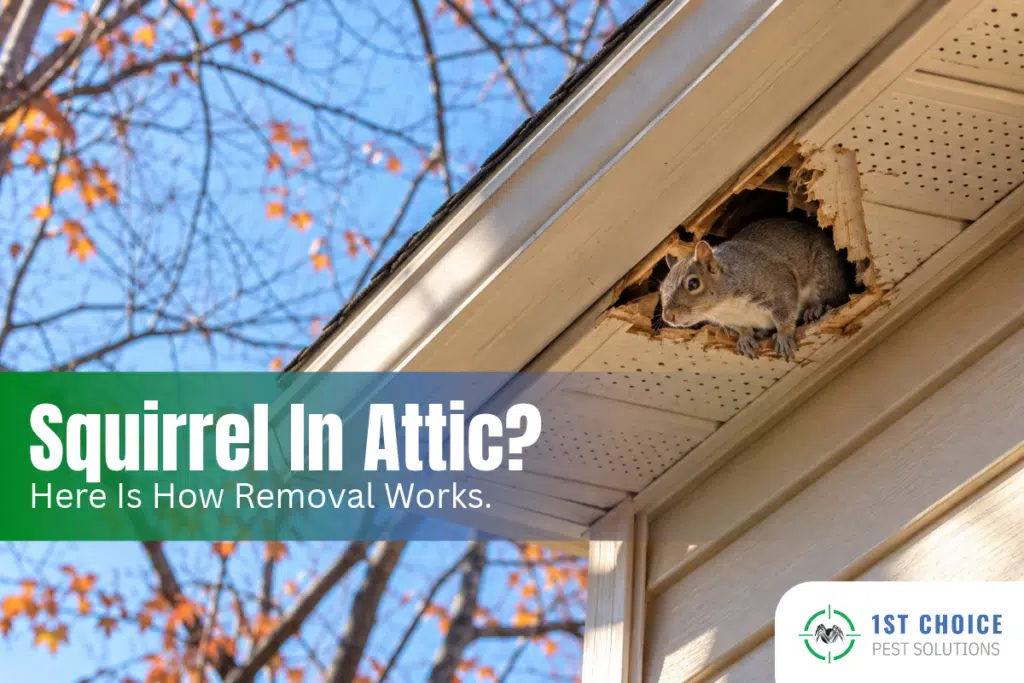 "]
Squirrel in Attic? Why Wisconsin Squirrels Move In Before Winter and How Removal Works
A squirrel in your attic is almost always a female looking for a warm, dry place to spend the winter and raise a litter, and…
 "]
How Much Does Rodent Pest Control Cost in Wisconsin? [2026 Price Guide]
Rodent pest control in Wisconsin is typically priced one of three ways: a one-time treatment, an initial service plus a few follow-up visits, or an…