
Squirrel in Attic? Why Wisconsin Squirrels Move In Before Winter and How Removal Works
October 26, 2026
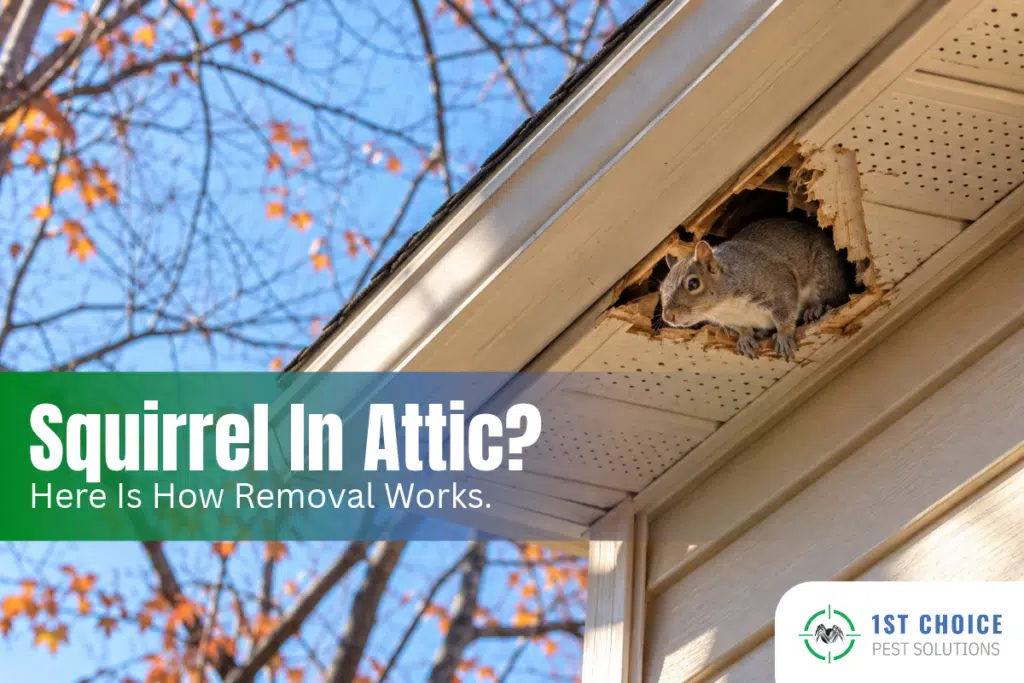
A squirrel in your attic is almost always a female looking for a warm, dry place to spend the winter and raise a litter, and she got in through a gap you cannot see from the ground. Scratching above the ceiling is not a sign the animal is trapped. It is a sign she has found a space she likes and intends to keep using. Getting her out for good takes two things: removing the squirrels that are inside and closing the opening they are using so the next one cannot follow the same path.
1st Choice Pest Solutions handles attic squirrels across western Wisconsin, including Eau Claire, Chippewa Falls, Menomonie, Somerset, Mondovi and Green Bay. Our technicians work in these houses every fall, and the pattern repeats: the first cold snap arrives, the noise starts, and the homeowner assumes it is mice until the sound is too heavy and too daytime to be a mouse.

Why Squirrels Pick Attics in Late Fall
Gray squirrels and red squirrels both stay active all winter in Wisconsin. They do not hibernate, so they need shelter they can use every single night from November through March. An attic gives them insulation to burrow into, no wind, no predators and a roof over the nest.
Late fall is also when the second litter of the year has grown up and dispersed. Young squirrels leave the nest they were born in and go looking for territory of their own, which is why a house that was quiet in August suddenly has company in October and November.
Roof lines give them plenty of ways in. Squirrels are climbers and chewers, and a soft spot in a soffit, a gap where a roof meets a dormer, a loose gable vent, or a rotted fascia board is all the opening they need. A squirrel can widen a hole the size of a golf ball into something it fits through in an afternoon.
How to Tell It Is a Squirrel and Not Something Else
Timing and sound tell you most of what you need to know before anyone climbs a ladder. Squirrels are day animals. Mice and bats are not.
| What You Hear | When You Hear It | Most Likely Animal |
|---|---|---|
| Heavy scurrying, rolling or dragging sounds | Early morning and late afternoon | Squirrel |
| Light scratching and tiny scampering | After dark, through the night | Mice |
| Scratching plus chirping or squeaking at dusk | Summer evenings, around sunset | Bats |
| Slow, heavy thumping and loud vocal noise | Night, usually overhead or in a chimney | Raccoon |
| Rapid drumming on siding or trim, no indoor noise | Daylight, spring and fall | Woodpecker |
Other evidence shows up outside. Look for a worn, greasy track along a branch that reaches the roof, chewed edges on a vent screen, shredded insulation pushed out of a soffit seam, or acorn shells and cone scales piled on a deck rail or in a gutter.
Nuts in odd places are a strong clue. Red squirrels in particular cache food near the nest, and homeowners often find a cup of sunflower seeds in a boot in the garage or a stash of acorns behind a stored box.
What Squirrels Damage Once They Are Inside
Insulation goes first. A nesting squirrel flattens and tunnels through batting until the attic floor loses much of its R value, and that shows up on a heating bill long before anyone goes up to look.
Wiring is the risk that worries us most. Squirrel teeth grow continuously and they gnaw to manage them, and Romex sheathing in an attic is exactly the right texture. Stripped wire in a nest of dry insulation is a fire hazard, and it is the single best reason not to wait out an attic squirrel until spring.
Urine and droppings soak into insulation and drywall over a winter of occupancy, which leaves odor and staining that often means removing and replacing material rather than cleaning it. Nesting females also chew interior access holes between attic bays, so one entry point can turn into damage across a whole roof section.

“The most common entry points are normal construction gaps around roof returns, which homeowners often overlook when inspecting the roof from the ground.”Matt, Technician, 1st Choice Pest Solutions
How Squirrel Removal Works, Step by Step
Inspection comes first, inside and out. A technician walks the roof line and the attic to find every active and potential entry point, identify the species, and determine whether there are dependent young in the nest, because that changes the sequence.
Removal follows the inspection. Depending on the situation, that means one-way doors mounted on the active entry so squirrels leave and cannot return, live traps placed on the roof or in the attic, or hand removal of a nest with young so the family is not separated inside a wall.
Exclusion is the part that ends the problem. Openings get sealed with materials squirrels cannot chew through, which usually means heavy gauge metal flashing, hardware cloth and sealed vent covers rather than foam or wood. Weak points that have not been breached yet get closed at the same time.
Cleanup and follow up finish the job. Contaminated insulation is removed where it needs to be, and the technician returns to confirm the doors and seals are doing their work and nothing new has opened.
Our wildlife work follows Wisconsin rules on protected species and humane handling. You can read more about what the program covers on the wildlife control page.
Why Trapping Alone Does Not End the Problem
Catching the squirrel that is in your attic today does nothing about the hole she came through. Squirrel territories overlap, and a vacant nest site with an open door is prime real estate. Homeowners who trap and release without sealing often have a new animal within weeks.
Scent is part of why. A used nest carries squirrel odor that other squirrels read as a safe, proven site, so the next one does not have to go looking for a way in. She already has directions.
Repellents, ultrasonic devices and mothballs do not solve it either. We get calls every November from people who tried all three, and the squirrel is still there. Physical exclusion is the only approach that holds up through a Wisconsin winter.
What You Can Do Before We Arrive
Keep people and pets out of the attic until the animal is gone. A cornered squirrel bites, and a frightened one will run rather than leave through the opening you want it to use.
Do not seal the hole yourself while you still hear noise. Closing the only exit traps the animal inside, which leads to chewing through drywall into a living space, or to an animal dying in a wall cavity.
Trim back branches that overhang the roof where you can do it safely and bring bird feeders in or move them well away from the house. Neither step removes a squirrel that is already inside, but both reduce the traffic on your roof line.
Chipmunks, Woodpeckers and the Other Fall Callers
Attic noise is not always a squirrel. Chipmunk control questions pick up in fall too, though chipmunks usually stay at ground level, in foundation gaps, window wells, retaining walls and under decks rather than up in an attic.
Woodpecker damage is a different problem with a similar sound. Rapid drumming on cedar siding, trim or a metal vent cap comes from outside the wall, and it is often a bird advertising territory or chasing insects in the siding rather than anything nesting in your attic.
Mice frequently share the building with squirrels. A roof gap that lets a squirrel in also lets mice travel the same route, so we check for both and can address rodent work through rodent removal on the same visit.
Frequently Asked Questions
How do I know if the squirrel in my attic has babies?
Repeated high pitched chirping or faint squealing from one spot, especially in late winter and early spring, usually means a litter. A technician confirms it during the attic inspection, and when young are present, we remove the nest by hand instead of using one way doors, so nothing is left behind in the wall.
Will a squirrel leave my attic on its own in spring?
Some do, and then they come back the next fall to the same spot. Squirrels reuse successful nest sites year after year, so waiting it out leaves the entry point open and the damage accumulating.
Is a squirrel in the attic dangerous to my family?
The main risks are structural and electrical rather than direct contact. Chewed wiring is a fire hazard, and droppings and urine in insulation create an odor and sanitation problem, but squirrels rarely come down into living space unless they get trapped or disoriented.
How soon can you come out to look at it?
Call us and we will give you the next available date for your area.
Do you relocate squirrels or kill them?
That depends on the species, the season and Wisconsin regulations, and the technician explains the approach for your situation at the inspection. Our goal on every attic job is to get the animals out, keep them out, and handle them humanely while doing it.
Does homeowners’ insurance cover squirrel damage in an attic?
Coverage varies a great deal by policy, and most policies treat rodent and wildlife damage as a maintenance issue rather than a covered loss. Document what you find with photos and ask your agent directly before assuming either way.
Getting a Squirrel Out of Your Attic
Noise overhead in November is worth acting on now rather than in March. Every week a squirrel stays in an attic adds insulation damage, droppings and another chance that the wrong wire gets chewed.
Call 1st Choice Pest Solutions at (715) 271-2511 and we will get a technician out to inspect the attic and the roof line, identify what is using it, and lay out what removal and exclusion will take for your house. You can also request an estimate online or check the service area page to confirm we cover your town.
Recent Posts
 "]
Exterminator in Eau Claire: How to Compare Local Pest Companies Before You Call [2026]
The honest way to compare an exterminator in Eau Claire is to ask every company the same five questions: who is licensed and insured, who…
 "]
Squirrel in Attic? Why Wisconsin Squirrels Move In Before Winter and How Removal Works
A squirrel in your attic is almost always a female looking for a warm, dry place to spend the winter and raise a litter, and…
 "]
How Much Does Rodent Pest Control Cost in Wisconsin? [2026 Price Guide]
Rodent pest control in Wisconsin is typically priced one of three ways: a one-time treatment, an initial service plus a few follow-up visits, or an…